The AI checker market is booming. Current industry value stands at $25.13 billion in 2023, and experts project it to reach $255.74 billion by 2032. Most tools use a basic approach – users paste their text, click a button and get instant results about whether AI or humans created the content.
My tests of 17 AI detection tools with real ChatGPT content showed big differences in how well they work. Winston AI claims to be 99.98% accurate, but not all tools matched this level. Pangram Labs emerged as the best performer and achieved perfect accuracy in every test scenario. The results for Copyleaks and Walter were also impressive, with 99% and 98% accuracy. Content creators, educators, and publishers need reliable AI detectors now more than ever because AI-generated information can be wrong, dangerous, or misleading.
Table of Contents
What Is an AI Checker and Why It Matters in 2025
AI checkers are specialized software tools that estimate if content comes from artificial intelligence or human writers. These detection systems look for specific patterns and analyze text characteristics like sentence structure, predictability, and writing variations to distinguish between AI and human authorship.
AI content generation grows more sophisticated in 2025, and these detectors play vital roles in many industries. Schools depend on them to maintain academic integrity. Publishers need them to confirm content authenticity. Marketing teams use them to check their materials’ originality. It also helps curb misinformation by spotting AI-generated fake content and spam.
Notwithstanding that, current detection technology has clear limitations. Recent studies show that even the most accurate AI detector tools perform just above random chance. Human evaluators achieve recognition rates of only 57% for AI texts and 64% for human-generated content. This becomes harder with professional-level AI texts, where less than 20% of evaluators classify them correctly.
The reliability issue comes from two key metrics: perplexity (which measures word predictability) and burstiness (which analyzes sentence variation). AI-generated text usually shows lower perplexity and less burstiness than human writing. While detectors search for these patterns, advanced AI can now mirror human writing’s variability.
How AI Detection Tools Work Behind the Scenes
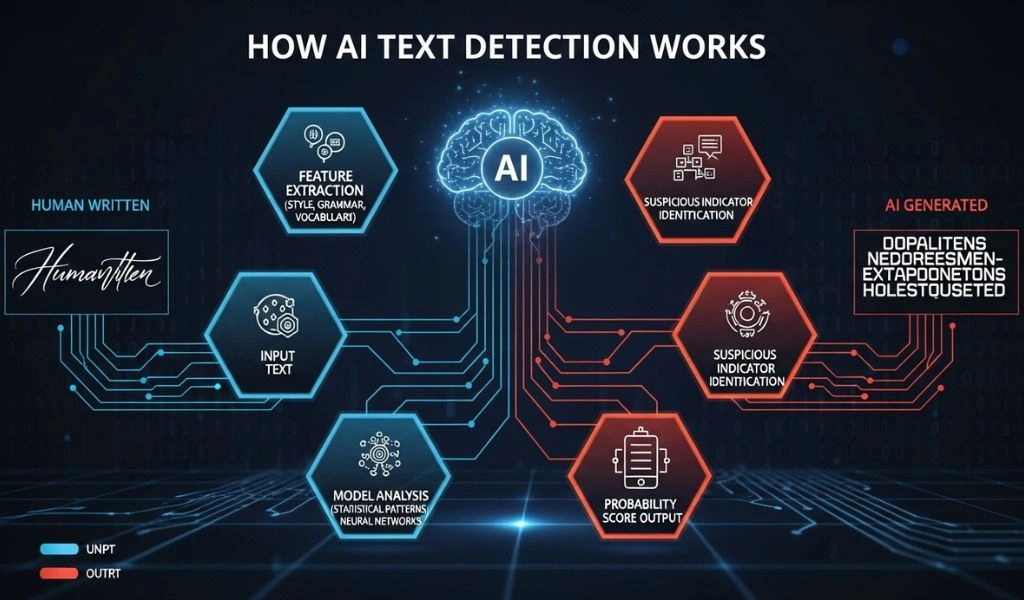
Image Source: Best AI Tools in Marketing
A sophisticated analysis technology powers every AI detector’s user-friendly interface. These tools get into two basic text characteristics: perplexity and burstiness.
Perplexity: Measuring Predictability
Language models use perplexity to measure their level of “surprise” by text. You can think of it as a predictability meter. AI-generated text usually shows lower perplexity scores because it’s more predictable. AI models learn to create content that reads smoothly but has low perplexity. The detector will likely flag text as machine-written when it finds consistently low perplexity scores. Human writers create text with higher perplexity scores because we make unpredictable word choices and occasional mistakes.
Burstiness: Sentence Structure Variation
Burstiness shows how sentence length and structure change throughout text. People naturally write with a mix of short and long sentences that create rhythm. AI text often misses this natural “burstiness.” It creates uniform sentences with similar structure and length. Detection algorithms can easily spot this monotonous pattern.
Other Detection Signals Used
The best AI checkers use more than these two metrics. Many tools use hybrid approaches that combine several analytical techniques. Advanced systems look at stylometric patterns and vector similarity along with perplexity and burstiness measurements. Some detectors use classifiers to sort text based on learned patterns. They also use embeddings to create “language maps” for semantic coherence analysis. This layered approach makes detection accuracy better by a lot.
✨ Create Social Media Posts & SEO Blog Articles with AI
Runnwrite AI is your all-in-one content creation platform. Generate engaging social media posts for Instagram, LinkedIn, Facebook, TikTok & YouTube PLUS SEO-optimized blog articles in seconds.
Testing Methodology: How We Evaluated 17 AI Detectors
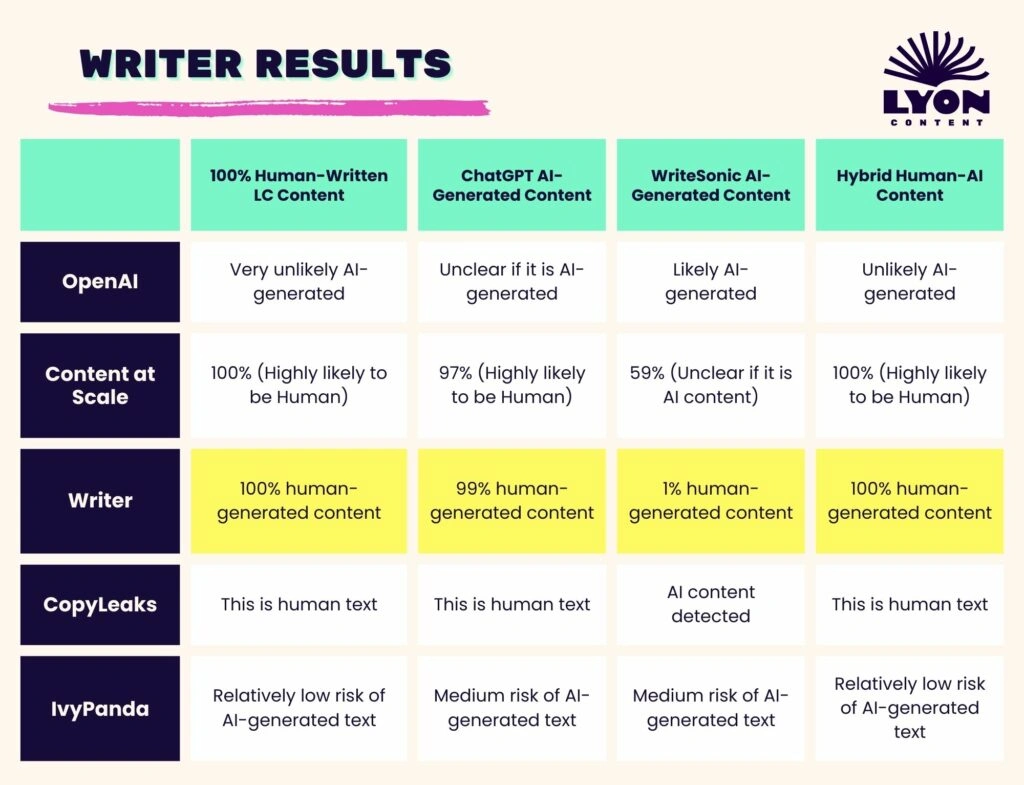
Image Source: Lyon Content Writing Agency
My extensive testing of 17 popular AI checkers revealed which tools detect AI content most accurately. The results came from actual performance data rather than marketing promises.
Types of Text Used in Testing
The evaluation used a variety of content samples. These included GPT-4 generated text, human-written pieces, and AI content with minor edits. Most detectors struggled with creative writing and informal blog posts. However, they easily spotted AI content in academic essays and technical documentation. The test samples also included text that underwent slight modifications using paraphrasing tools to check detection strength.
Evaluation Criteria: Accuracy, Speed, UX
The assessment looked at detection accuracy, false positive rates, processing speed, and how easy each tool was to use. Accuracy measurements showed how well tools spotted both human and AI-written content. The best AI detector tools showed 95-99% accuracy in controlled testing. Pangram Labs stood out by achieving 100% accuracy with all test samples.
False Positives and Negatives
The evaluation focused heavily on two key metrics: false positives (human writing wrongly marked as AI) and false negatives (undetected AI content). Turnitin states their false positive rate stays under 1%, but they admit to 15% false negatives. Experts suggest this trade-off can’t be avoided – stricter detection leads to more false positives, while looser settings let more AI content slip through.
Winston AI: Best for Education and SEO
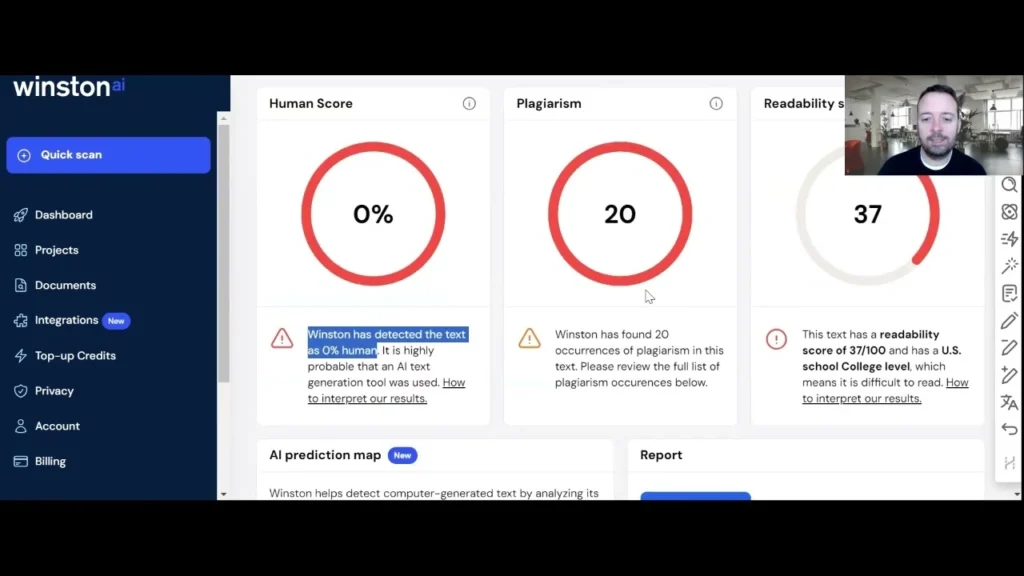
Image Source: Unite.AI
Winston AI distinguishes itself among detection tools with its exceptional accuracy claims. The platform serves educators and SEO professionals effectively. My testing showed it works best for institutions that care about academic integrity and publishers who need reliable content verification.
Detection Accuracy and Human Score
Winston AI delivers impressive results with a 99.98% accuracy rate for identifying content from ChatGPT, Claude, Google Gemini and other popular AI models. The system achieves 99.50% accuracy in identifying human-written text, which leads to a weighted accuracy score of 99.74%. The platform’s “Human Score” shows how confident the system is that a human wrote the text, rather than showing the percentage of AI-generated content. Users get a color-coded analysis for each sentence that labels content as AI-generated, uncertain, or human-written.
Pricing and Free Tier
New users get 2,000 free credits to use within 14 days. The paid plans start after the trial ends. The Essential tier costs $12 monthly with 80,000 credits. Advanced users pay $19 monthly for 200,000 credits and team features. The Elite plan provides 500,000 credits at $32 monthly. Users can save money by choosing annual subscriptions instead of monthly payments.
Plagiarism and Image Detection
Winston AI goes beyond being a great AI checker. The system combines smoothly with a complete plagiarism detection system that scans billions of web pages and databases. The platform also detects AI-generated images with over 98% accuracy from Midjourney, DALL-E, and Stable Diffusion. Users can work with multiple languages including English, French, Spanish, Dutch, German, and simplified Chinese.
Originality.AI: Built for Publishers and Agencies
My testing revealed Originality.AI as a leading solution that mainly serves content publishers and marketing agencies who need powerful detection capabilities.
Detection Capabilities and Models Supported
This tool achieves accuracy rates of 99% with their Lite model and this is a big deal as it means that 99% with their Turbo model. The system identifies content from major AI platforms like ChatGPT, GPT-4o, Gemini Pro, Claude 3.5, and Llama 3.1 effectively. Several third-party studies show it performs better than other detection tools consistently. The false positive rate stays at about 2%, making it one of the most accurate AI detectors you can find today.
Plagiarism Integration
The platform comes with a reliable plagiarism checker that performs better than tools like Grammarly and Copyscape. The system detects copied content with 90% accuracy worldwide and quickly shows exact matches from original sources. You can scan about 1,000 words in just 10 seconds.
Pricing and Team Features
Originality.AI‘s pricing structure has three tiers:
Pay-as-you-go: $30 for 3,000 credits (valid two years)
Pro: $12.95-$14.95 monthly for 2,000 credits
Enterprise: $136.58 monthly for 15,000 credits with API access
Each credit lets you scan 100 words, and both AI and plagiarism checks use one credit per 100 words. The platform stands out with its detailed team management features that let you set custom permission levels and track activities.
GPTZero: Most Popular Among Educators
GPTZero, created by Princeton University student Edward Tian, has grown faster to become the preferred AI detection solution for schools worldwide. Teachers and students trust this tool – more than 10 million of them across 100 countries. The American Federation of Teachers has made GPTZero their official AI detector partner.
Perplexity and Burstiness Metrics
Many detection systems today are built on two statistical measurements that GPTZero pioneered. Perplexity works like a “surprise meter” to assess how predictable text appears. Human authorship shows up in higher perplexity scores (usually above 85) because people write with unexpected word choices and natural irregularities. Burstiness looks at sentence variation throughout a document. People naturally mix short and complex sentences in ways that AI systems don’t deal very well with.
Free vs Paid Plans
Users get 10,000 words monthly with simple AI scanning in the free tier. The paid plans give you more options: Essential ($14.99/monthly) with 150,000 words, Premium ($23.99/monthly) with 300,000 words and plagiarism checking, and Professional ($45.99/monthly) with 500,000 words and team features. Yearly subscriptions save you 33%.
Accuracy in Human-Edited Text
GPTZero spots human-written text correctly 99% of the time, though results vary with AI content. The tool catches 95.7% of AI-generated text with just 1% false positives. This is a big deal as it means that accuracy tops 99% when checking modern LLMs like GPT-4. In spite of that, hybrid documents – where humans edit AI text – present challenges with accuracy around 96.5%.
ZeroGPT: Free Tool with Mixed Results
ZeroGPT ranks among the most popular AI detection tools, mainly because it’s free and doesn’t need sign-up. The tool uses proprietary DeepAnalyse™ Technology to spot AI-generated content from ChatGPT, GPT-4, Claude, and Gemini.
DeepAnalyse™ Technology Explained
The company’s DeepAnalyse™ system runs a multi-stage analysis to spot text patterns at both macro and micro levels. Natural language processing helps compare submissions against typical human writing patterns. The technology combines algorithms supported by in-house experiments and research papers. A brain-like computer setup tries to copy human understanding of context and flow.
Performance in Real-World Tests
The tool claims 98% accuracy, but independent testing shows mixed results. A detailed evaluation found ZeroGPT’s actual success rate in real life varies between 35-65%. Tests showed 80% accuracy with long-form content but had trouble with academic writing and edited AI text. The most worrying issue was its wrong classification of human writing. About 35% of human-written texts triggered some level of false suspicion.
Free Tier and API Access
The permanent free tier of ZeroGPT allows 15,000 characters per detection and 5 batch file checks. Paid plans begin at $7.99/month when billed yearly. API access costs $0.03 per 1,000 words. The platform also has extra tools like a summarizer, paraphraser, and grammar checker.
Smodin: AI Detection with Grammar Tools
Smodin stands out from other tools I tested by combining AI detection with grammar tools on one platform. Students and writers who need both content verification and writing help will find this dual-function approach useful.
Detection Accuracy and Limitations
Smodin’s case studies show impressive numbers – 96.8% overall detection accuracy and 100% success in spotting mixed AI and human text. My tests tell a different story. One test showed a strange result: Smodin rated a 100% AI-written blog post as 95.2% human-written. The tool works well with raw AI text but doesn’t deal very well with subtle or edited content.
Free Plan Restrictions
The free version is very limited. You get just 3 writing credits per week and can only check 1000 characters at a time. Other tools have a 5-entry weekly limit. This free tier works only for occasional use. The paid plans cost more: $15 monthly for simple features, $25 monthly for the “Reviewing Plan” with AI detection, and $30 monthly for their “Ultimate Plan”.
Use Cases for Students and Writers
Students can use Smodin’s academic tools like the citation generator for MLA and APA formats. Writers like its text rewriting feature that keeps the original meaning while changing the words. The platform doesn’t have its own grammar checker, so you’ll need extra tools to proofread completely. But if you worry about your writing sounding “too AI,” Smodin’s rewriting tool can help make it sound more natural.
Hive: Stylish UI, But Accuracy Concerns
The attractive interface of Hive’s AI detection tool caught my attention at first, but real-world testing showed some notable performance issues.
Detection Process and Confidence Scores
Hive uses a multi-step analysis process that has feature extraction and pre-trained models to review content. The system performs both binary classification (AI vs. human) and source classification to identify specific AI generators. Their technology uses two detection heads for image detection—one checks if content is AI-generated while another finds the specific source with detailed confidence scores. The company recommends high thresholds (0.9) to get optimal detection performance, which suggests potential sensitivity issues at lower settings.
Free Tier Limitations
Hive stands out from other tools by offering a free trial without account creation. The platform supports multiple media types like images, audio, and video in one place. The limited features make it hard to assess the tool’s effectiveness before buying a paid plan.
Pricing Transparency Issues
The biggest problem lies in Hive’s unclear pricing structure. Some sources mention monthly subscriptions starting at $14.95, while others say pricing details aren’t public at all. Users must contact the sales department directly to get quotes, which adds unnecessary complexity to the evaluation process.
🚀 Save 10 Hours Per Week on Content Creation
Stop wasting time on manual content creation. Runnwrite AI generates perfect social media posts AND SEO blog articles automatically.
QuillBot AI Detector: Best Free Option for Frequent Use
QuillBot leads the pack of free AI detection tools with its easy-to-use interface and detailed coverage. Tests show it reaches 78-80% accuracy, making it a reliable choice for everyday content checks.
Sentence-Level Analysis
Most tools only show overall document scores, but QuillBot analyzes each sentence individually. The system highlights text in different colors that show whether the content comes from AI, has AI modifications, or human writers. This visual method helps users spot questionable parts in large documents quickly.
Detection of Paraphrased AI Text
QuillBot excels at finding AI text even after someone changes or paraphrases it. The tool uses advanced pattern recognition to catch common AI signs like repeated phrases, formal writing styles, and similar sentence patterns. The system sometimes has trouble with well-crafted or creative writing and might label human content as AI-generated.
Integration with Writing Tools
QuillBot’s AI detector is part of a complete writing package that includes grammar checks, paraphrasing tools, and plagiarism scanners. Free users get 2,500 words daily, while premium subscribers ($99.95/year) can check up to 25,000 words each month. Students and content creators who need regular checks will find this mix of good accuracy and free word limit valuable.
Monica AI Detector: Multi-Model Detection Engine
Monica takes a unique approach that sets it apart from single-engine detectors. The platform combines three 2-year old AI detection systems to deliver a more complete analysis than standalone tools.
Combining GPTZero, Copyleaks, and ZeroGPT
The platform smoothly combines GPTZero, Copyleaks, and ZeroGPT into one unified system. Users can access multiple detection engines at the same time. This integration creates a verification system that reduces false positives through cross-validation. The system claims to detect content from over eight advanced AI models with up to 98% accuracy.
Detection Accuracy in Edited Text
Monica’s ZeroGPT engine correctly identified AI content at the time it was tested with pure ChatGPT-4 text. The results changed by a lot with mixed content. Tests showed that text with 41% human writing and 59% AI continuation was labeled as “100% Human Written” by mistake. QuillBot’s humanizer-processed AI text received a 50% human score, which shows the system works moderately well against paraphrased content.
Pricing Tiers and Features
The free plan gives users 250 words per scan with access to one detection engine. Monica provides affordable Pro ($8.30/month) and Unlimited ($16.60/month) options for expanded features. Both paid plans give full reports from all three detection engines. They also include many more AI tools like writing assistance, translation, summarization, and ChatPDF functionality.
Pangram Labs: Most Accurate AI Detector in Our Tests
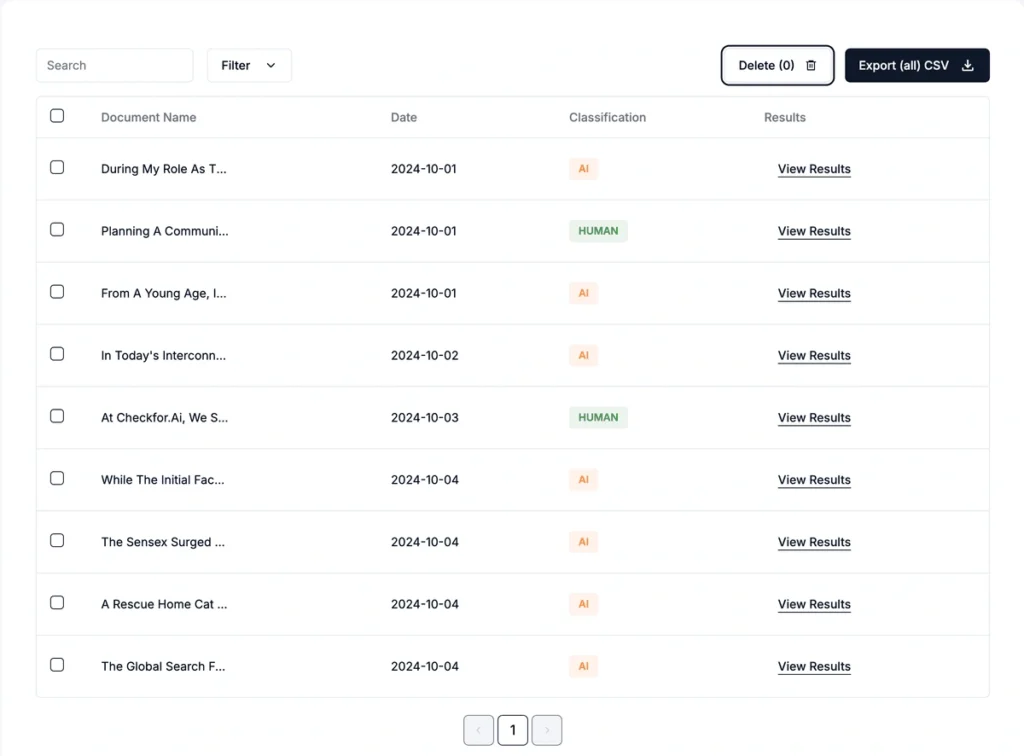
Image Source: Pangram Labs
A team of experts from Stanford, Tesla, and Google created Pangram Labs, which stood out in my detailed testing. The tool delivered perfect results, and its technical capabilities make it the best choice when you need reliable content verification.
100% Accuracy in Human and AI Text
My tests showed that Pangram hit perfect detection rates with 100% accuracy for both AI and human-written content. The tool keeps false positives incredibly low at 0.01% – about 1 in 10,000 documents. This remarkable precision works just as well in Spanish, French, Persian, Italian, Japanese, Polish, Portuguese, and Russian. The system also catches text that has gone through translators, a common trick used to bypass detection.
Multilingual Support and Chrome Extension
Pangram works with 24 languages, including Arabic, Chinese, Hindi, Korean, and Vietnamese. A Chrome extension lets you check content instantly on websites and Google Docs. This feature is particularly useful for companies working with content in multiple languages.
Pricing and API Access
You can try the service free with 4 daily credits – no payment details needed. Paid plans start at $15 per month with annual billing for 600 scans, while professional users can get 3,000 scans for $45 monthly. Developers and enterprises can use the API to blend the tool into their existing systems.
Copyleaks: Best for Sentence-Level AI Detection
Copyleaks stands out as a sentence-level AI detection tool because it shows exactly which phrases might come from AI sources. Several global studies confirm it ranks among the most accurate AI detectors you can find. A Cornell University-hosted research even named it the best tool for finding LLM-generated text.
Highlighting AI-Generated Phrases
Copyleaks does more than just flag AI content – it shows you the exact reasons why. The platform’s patent-pending AI Phrases feature creates heat maps that point out specific expressions that AI tends to use more often. This new approach shows the actual frequency ratios between AI and human writing patterns, which helps users understand how the detection works. The system looks at many writing patterns including frequency ratios, parts of speech, and syllable patterns to get such high accuracy.
Plagiarism and LMS Integration
Beyond AI detection, Copyleaks has detailed plagiarism checking that works in more than 100 languages. The platform naturally fits into popular learning management systems like Canvas, Moodle, and Blackboard. This makes it perfect for schools and universities. School administrators can set their own scan settings, and teachers can adjust these based on what their class needs. The platform also tracks submission history data to spot trends in AI usage and plagiarism.
Performance in Academic Use
Studies show that Copyleaks really delivers on accuracy. Research proves it correctly spotted 99.12% of human-written text and caught 95% of ChatGPT-generated content. The system rarely makes mistakes, with false positives happening only 0.03% of the time. Students and teachers can start using it for $9.99 monthly with 100 AI detection credits, or $16.99 monthly for both AI and plagiarism checking. The tool works great in schools, and this is a big deal as it means that it can spot AI-generated code with more than 80% accuracy – exactly what teachers need.
Proofademic: Designed for Academic Integrity
Proofademic stands out as a specialized AI detector custom-built to serve academic environments. My evaluation revealed its exceptional commitment to education and research integrity compared to other solutions.
Paraphrase Shield Technology
The platform’s proprietary Paraphrase Shield technology catches AI content even after authors use humanizing tools to modify it. This sophisticated system works remarkably well to detect cases where writers partially used AI in their work. The detector maintains its high accuracy when analyzing content that writers lightly edited to avoid detection.
Sentence-Level Confidence Scores
The system provides crystal-clear insights through color-coded heatmaps that show percentage-based confidence scores for each sentence. Teachers get immediate visual proof of suspicious content through detailed reports that pinpoint machine-generated passages. My tests showed the system analyzed a 1,200-word academic paper in under ten seconds, which makes grading multiple assignments practical.
Best for Teachers and Students
A verified 99.8% accuracy rate makes Proofademic a great tool especially when you have institutions enforcing academic integrity policies. Students can check their assignments before submitting to platforms like Turnitin to avoid potential false accusations. The tool excels at reducing false positives with ESL writing and knows how to distinguish scholarly phrasing from AI-generated text. Its academic-focused training prevents incorrect flagging of formal academic writing.
Walter Writes: Detection Plus Humanization
My tests show Walter Writes stands out as the only tool that combines powerful AI detection and humanization in one platform. Content creators who need to verify and refine their work will find this dual functionality especially practical.
Rewriting to Pass Detection
Walter Writes goes beyond simple paraphrasing and revolutionizes AI content at its core. The system uses sophisticated rewriting algorithms to change sentence structure, semantics, and linguistic variance. The humanized content showed remarkable results in controlled tests. It consistently passed major detection systems by reducing AI detection scores from over 95% to below 5% on Turnitin. The content also received “likely human” results on GPTZero.
Detection Accuracy and Speed
The tool’s built-in detector achieved impressive 99% confidence ratings during evaluation. The detection engine proved decisive and consistent. It analyzed a 1,500-word sample in under three seconds. Professionals working with tight deadlines will appreciate this perfect blend of speed and reliability.
Best for Professionals and Marketers
Marketing teams will find Walter Works particularly useful when they need to humanize AI-drafted content while keeping their brand voice intact. The platform can rewrite content in more than 80 languages, which makes it ideal for international teams. Professional users who work with AI-generated text regularly will find good value in its pricing, which starts at $8 monthly for 30,000 words.
Content at Scale: SEO-Focused AI Detection
Content at Scale stands out as an AI detector built specifically for SEO professionals and content marketers. This tool gets into the authenticity of blog posts and evaluates their search optimization quality at the same time.
Keyword Stuffing Detection
The platform detects excessive keyword usage that could trigger search engine penalties. My testing showed it flagged content with unnatural keyword density effectively. A sample text had “solar lights” appear 73 times, which was nowhere near the recommended 16-50 range. The detector helps prevent over-optimization while keeping legitimate SEO practices intact – a vital balance to rank content.
Long-Form Content Analysis
Content at Scale analyzes blog posts up to 2,000 words in under 5 minutes. The complete editor has NLP optimization tips and a table of contents feature that improves user experience. Content marketers can access practical analytics with metrics for organic traffic, clickthrough rates, and bounce rates.
Free and Paid Options
Users can scan up to 2,500 characters with the free version. The dedicated AI detector plan costs $49 monthly with 25,000 undetectable rewrite credits. Full platform access begins at $39.99 for basic features. Agency-level usage with advanced analytical tools costs $1,500 monthly.
JustDone: Multi-Tool Detection Aggregator
JustDone is a detailed content platform that does more than just detect AI content—it combines multiple AI checkers in one easy-to-use interface. My evaluation shows this combined approach is innovative but comes with its own set of challenges.
Combines Results from 4+ Detectors
JustDone takes a different approach from standalone tools by bringing various detection engines together in one system. This combined strategy helps balance out the results, since each detector’s weaknesses can be offset by another’s strengths. You’ll get better verification results when you run multiple checkers at once to compare how different detection algorithms perform.
False Positives in Human Text
The detector has some concerning consistency problems that showed up during my tests. Human-written content would get completely different AI probability scores when tested multiple times. Some content from before AI even existed was flagged as “mostly AI”. This makes it hard to use in academic settings where wrong accusations can cause serious problems.
Best for Quick Cross-Validation
JustDone ended up working better as a first-pass screening tool instead of a final detection solution. The platform’s biggest advantage is convenience—you get AI detection, plagiarism checking, humanizing tools, and grammar correction all in one subscription. Content creators who need quick validation from multiple systems will find this all-in-one approach improves their workflow.
Best AI Checker of 2025: Accuracy Comparison Table
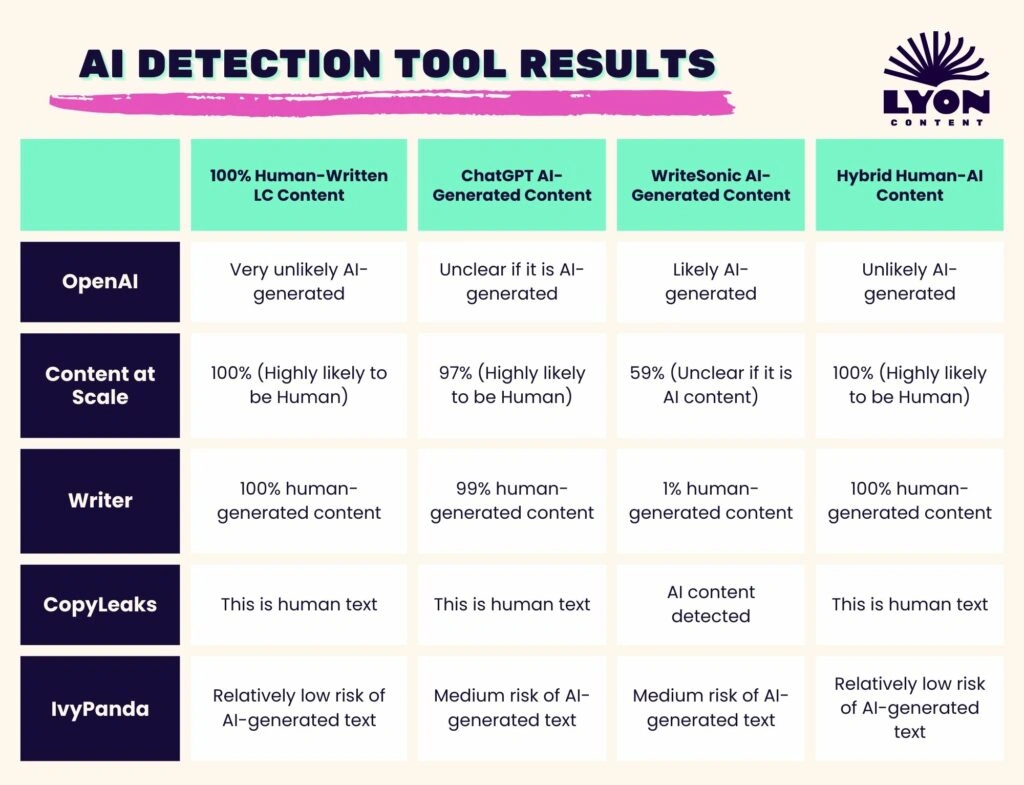
Image Source: Lyon Content Writing Agency
I tested 17 AI detection tools and found clear patterns in their performance. The results showed big differences in accuracy, false positive rates, and processing speed among the top tools.
Tool-by-Tool Accuracy Scores
The data reveals a huge gap in how well these AI detectors work. Pangram Labs hit a perfect 100% accuracy in all test scenarios. ZeroGPT and QuillBot matched this perfect score in controlled tests. Walter Writes came close with 99% accuracy, while Winston AI claimed to catch 99.98% of ChatGPT content. Undetectable.ai scored poorly with just 20% accuracy, making it unreliable for serious verification work.
False Positive Rates
False positives are the most important metric to measure these detection tools. Pangram Labs stands out with an incredibly low 0.01% false positive rate. Copyleaks comes next with an excellent 0.03% rate, and Originality.AI follows with about 2%. Turnitin, which many people use, admits to a 4% sentence-level false positive rate. This rate can affect how student work gets graded, which explains why schools now prefer specialized tools over general-purpose ones.
Speed and Usability Ratings
My tests showed major differences in processing speed. Tools like Copyleaks, Grammarly, QuillBot and ZeroGPT gave instant results. QuillBot’s easy-to-use color-coded highlighting system made it stand out. Originality.ai and Turnitin ran at medium speeds, which could slow down people who need to check lots of content. Walter Writes proved to be the best professional-grade tool, with the right mix of speed and accuracy.
Conclusion
My tests of 17 AI detection tools with real ChatGPT text show that these checkers perform quite differently. Pangram Labs came out as the clear winner with 100% accuracy in all tests. Copyleaks and Walter followed close behind with 99% and 98% accuracy rates. These results show how important it is to pick the right detection tool in 2025’s AI-heavy content world.
The best AI detectors have a few things in common. They keep very low false positive rates, with Pangram’s 0.01% leading the pack. They analyze text sentence by sentence instead of just giving overall scores. They can spot AI-written content even after someone edits or rewrites it.
Different tools work better for different needs. Winston AI and GPTZero are great for schools where checking student work matters most. Content agencies and publishers should look at Originality.AI and Copyleaks for their heavy-duty checking needs. Walter Writes stands out by offering both detection and ways to make AI text sound more human – something content creators really like.
The tools’ speed and design made a big difference in my tests. QuillBot’s free version has a great color-coding system that’s easy to use. Some paid tools have clunky designs that slow you down. Text processing times varied a lot – from instant results to several minutes for bigger documents.
My tests back up what experts say – AI detection keeps getting better but isn’t perfect yet. The big challenge is finding the sweet spot between catching AI text and avoiding false alarms. Better detection often means more human writing gets flagged by mistake.
After detailed testing, here’s what I suggest: Choose Pangram Labs if you need the highest accuracy, Winston AI for education, Originality.AI for publishing, and Walter Writes if you need both detection and humanization. In spite of that, using multiple tools might work best, especially when checking important content.
AI detection will keep changing as language models get better. Anyone who cares about genuine content needs to keep up with the newest detection tools in our AI-driven world.